Project Overview
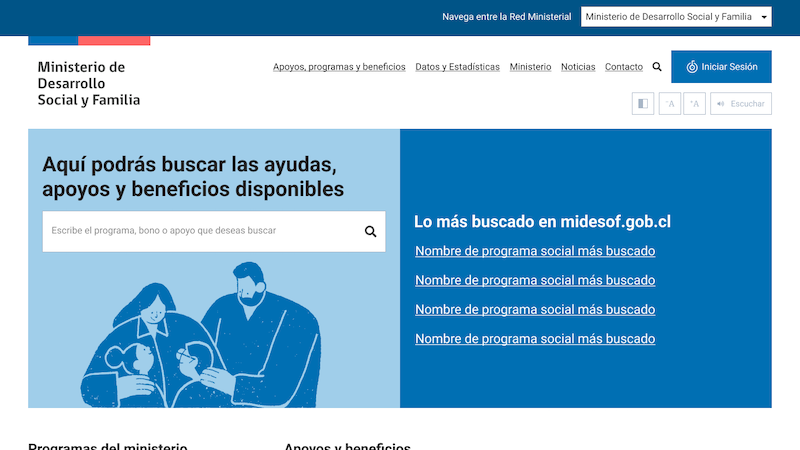
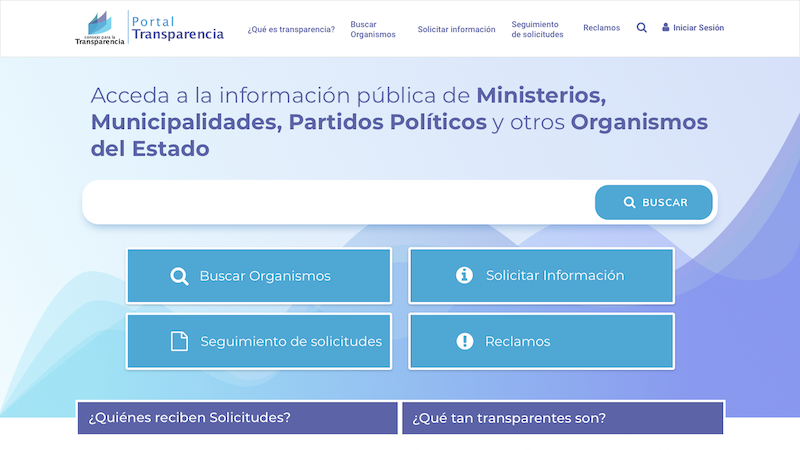
The Treasury General of the Republic of Chile (TGR) commissioned a comprehensive redesign of their Municipal Portal — the platform used by municipal officials across the country to access payment information, process transactions, and communicate with the Treasury. Building on two previous TGR engagements (usability audit in 2020-2021 and Help Center/Payment Center redesign in 2022), this project took a field research-first approach: we traveled across Chile to interview municipal officials in their actual work contexts before designing solutions.
Challenges
Through preliminary analysis and stakeholder consultation, we identified critical challenges with the existing portal:
- Fragmented Information: Payment data was scattered across different sections of the site (public news area and password-protected section)
- Lack of Payment Detail: Municipal officials struggled to identify the purpose of received payments
- Poor Communication Channels: Users had difficulty contacting TGR when questions arose
- Absence of Notifications: No system to alert users about upcoming payments
- Accessibility Issues: The portal's accessibility fell short of WCAG 2.1 standards
- Complex Authentication: Shared municipal credentials created security and management issues
Process
Milestone 1: Nationwide Field Research
The research phase was the backbone of this project. We conducted 10 in-depth field interviews across Chile — 7 with municipal financial officials and 3 with regional treasurers — traveling to municipalities of different sizes and geographic contexts:
- Puente Alto (Santiago metro area)
- Santiago (capital)
- Freirina (Atacama region)
- Lota (Biobío region)
- Quinchao (Chiloé archipelago)
- Curarrehue (Araucanía region)
- Chépica (O'Higgins region)
- Coquimbo (Coquimbo region)
- Aysén (Aysén region)
- Antofagasta (Antofagasta region)
All interviews were video-recorded and transcribed, providing a rich dataset for analysis. This nationwide coverage ensured we captured the diversity of municipal contexts — from large urban municipalities to small rural ones, from northern desert to southern archipelago.
From this research we produced:
- User Personas: Detailed profiles of municipal financial administrators based on real interview data
- Municipality Profiles: Contextual analysis of how different municipal sizes and locations affect portal usage patterns
- TGR Sponsor Analysis: Mapping the stakeholder landscape within TGR's organizational structure
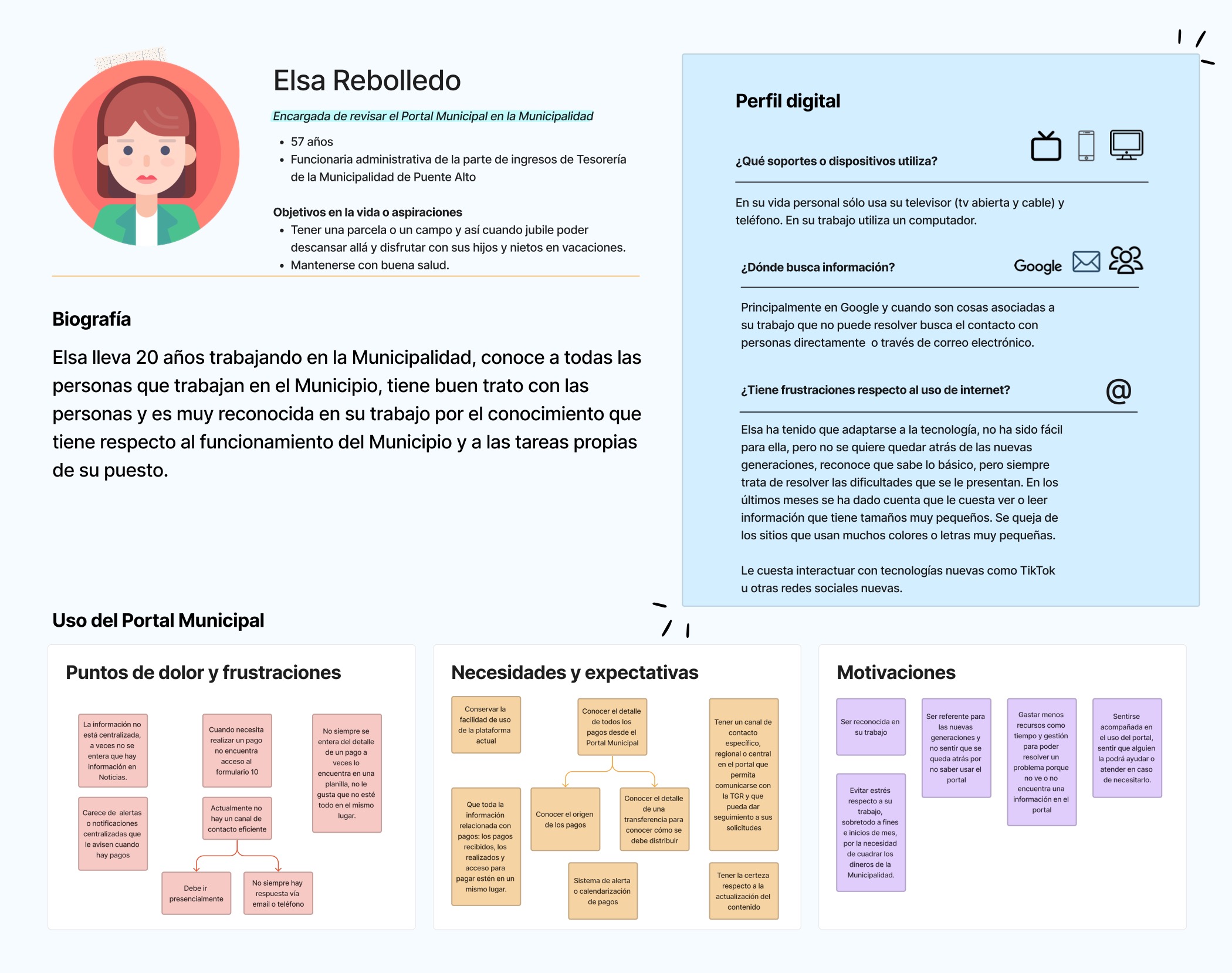 Click to view full image
Milestone 2: Design, Prototyping & Testing
 Click to view full image
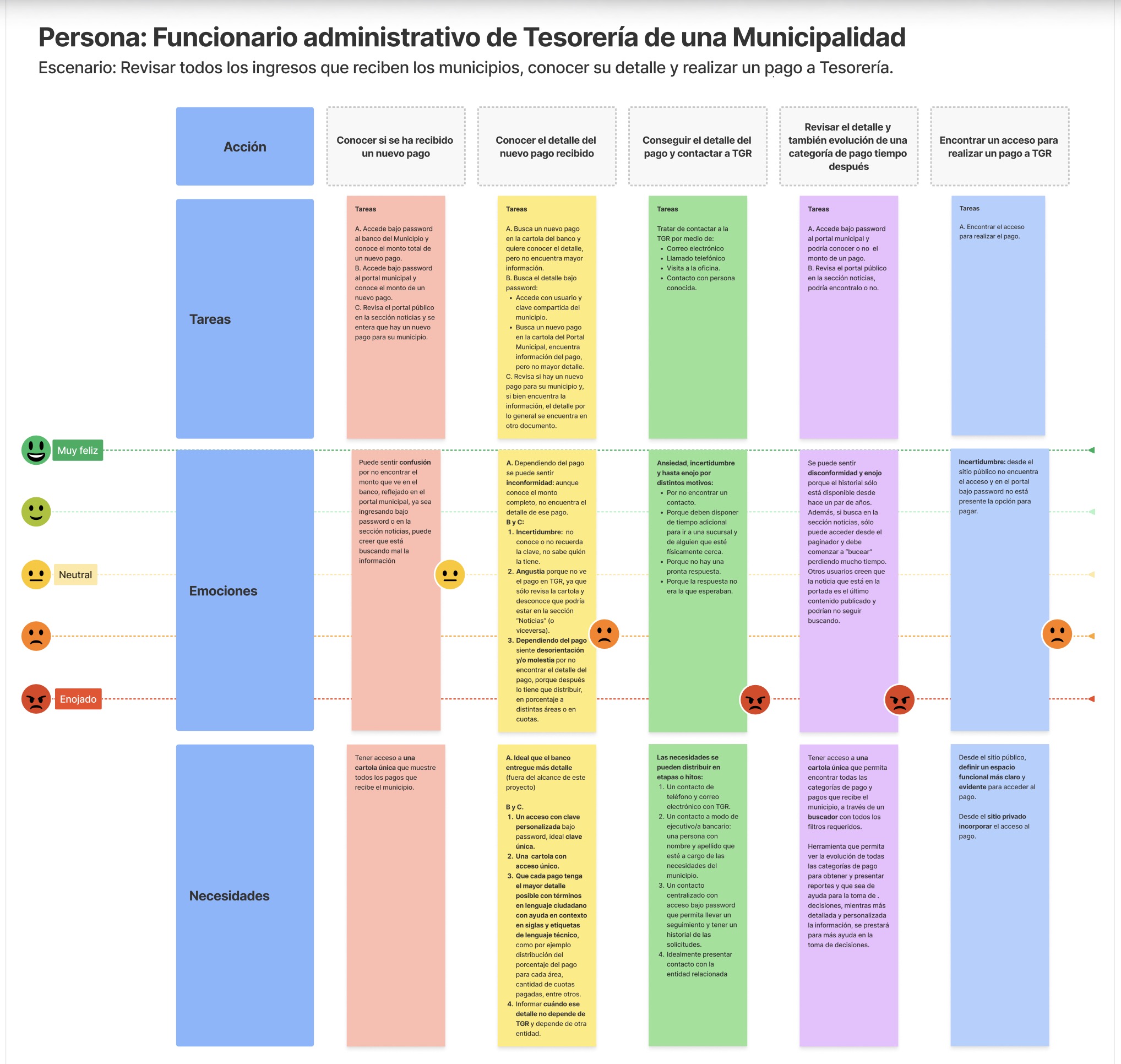
Based on the research insights, we developed a comprehensive design proposal:
- Empathy Maps: Synthesizing what users think, feel, say, and do when interacting with TGR's services
- Content Diagrams: Mapping the information architecture of the new portal
- Proposed User Journeys: Redesigned flows addressing the pain points identified in field research
- Design System: Component library ensuring visual consistency across the portal
- High-Fidelity Figma Prototype: Interactive designs for all key portal screens
- User Testing: Validation sessions with municipal officials using the interactive prototype
Key Features of the Redesign
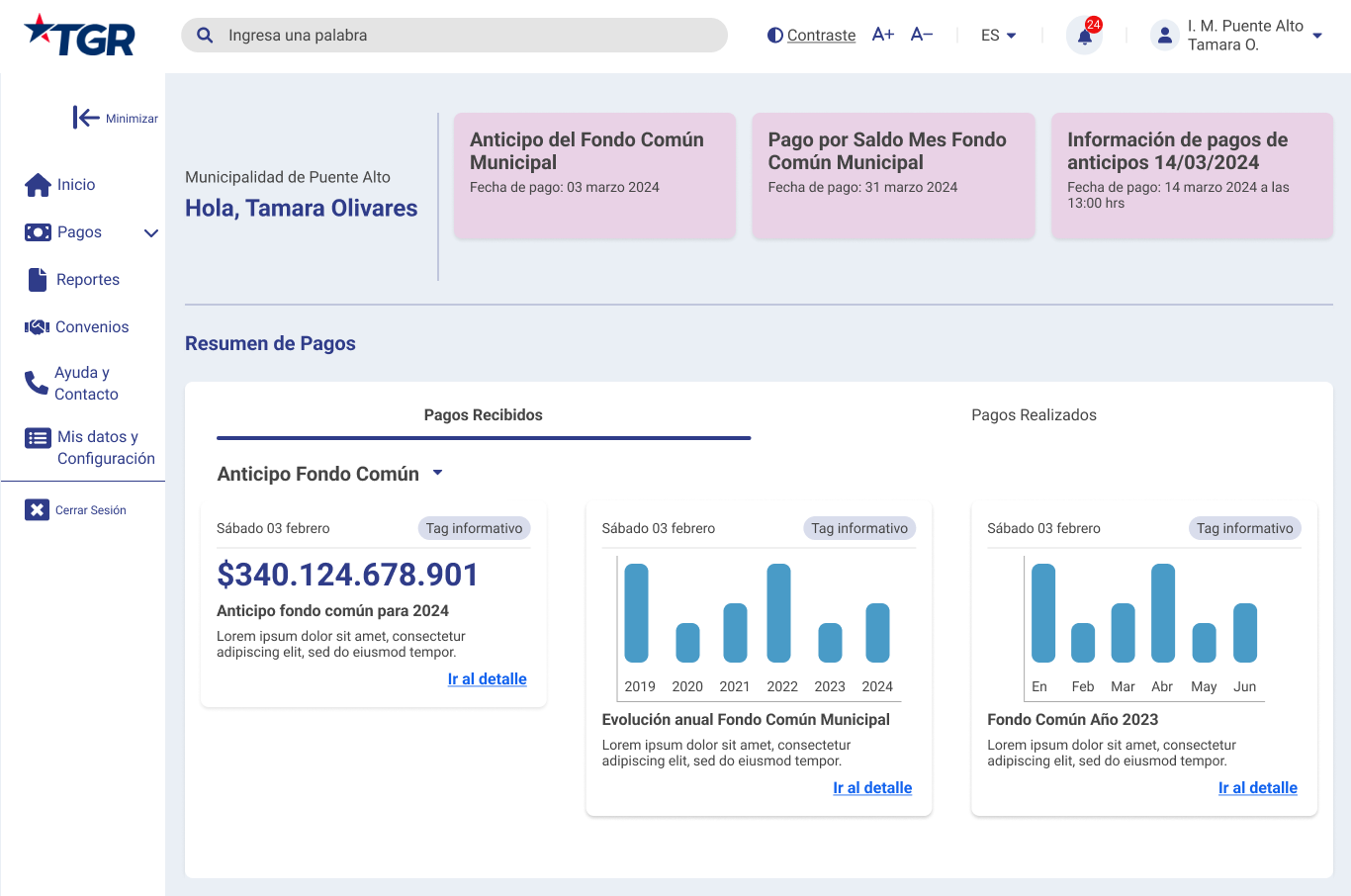
- Unified Payment Dashboard: Consolidating all payment information (received and made) in a single view
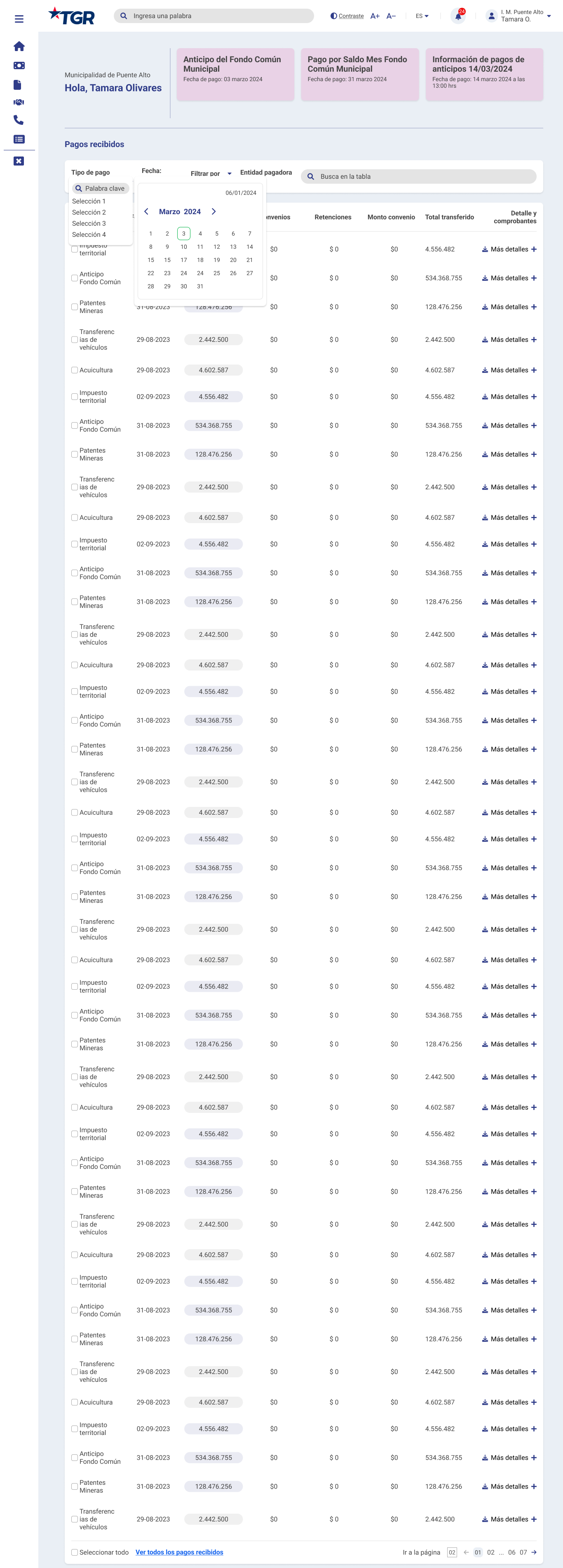
- Enhanced Payment Detail: Comprehensive information for each payment, with downloadable certificates
- Personalized Authentication: Individual access with ClaveÚnica (Chile's digital identity system)
- Data Visualization: Graphical representation of payment trends and financial data
- Notification System: Alerts for upcoming payments and relevant deadlines
- Improved Contact System: Ticketing system with tracking and response time indicators
- Responsive Design: Fully functional across all devices
- WCAG 2.1 Compliance: Meeting accessibility standards for all users
 Click to view full image
Results
The redesigned portal received mostly positive feedback during user testing, along with actionable findings that informed further refinements:
- Simplified Navigation: Users reported finding information more intuitively
- Increased Efficiency: Reduced time spent searching for payment details
- Enhanced Visibility: Better financial overview through data visualization
- Improved Communication: Clear channels for resolving payment inquiries
- Greater Autonomy: Less dependency on phone calls to resolve simple issues
"This is much more user-friendly than the current portal. I can find everything I need without having to search through multiple sections." Municipal Financial Administrator
Users consistently highlighted that consolidating payment information in a single view would significantly reduce the time spent searching across multiple sections. Usability testing synthesis
Implementation Plan
We delivered a detailed roadmap for implementing the redesign in three phases:
- High-Impact Core Features: Unified payment dashboard, authentication system, and basic contact functionality
- Medium-Priority Enhancements: Data visualization, advanced filtering, and reporting capabilities
- Complementary Features: Advanced user management, custom alerts, and additional integration points
Additionally, we delivered a co-creation plan defining internal and external collaboration processes for the ongoing development of the portal.
Key Deliverables
- 10 Field Interview Transcriptions with video recordings
- User Personas based on nationwide research
- Empathy Maps synthesizing user insights
- Content Architecture Diagrams
- Proposed User Journey Maps
- Design System with reusable components
- High-Fidelity Figma Prototype (tested version)
- Implementation Roadmap with phased feature rollout
- Co-Creation Plan for internal/external collaboration