Project Overview
The Ministry of Social Development of Chile commissioned a UX diagnosis and redesign of the Red Clase Media Protegida (RCMP) — a citizen-facing platform designed to help middle-class families discover and access social benefits when facing adverse life events such as health crises, unemployment, or elder dependency.
The platform was in beta and needed expert evaluation before launch. We restructured the entire content architecture, built and tested navigable prototypes, and delivered validated screen designs — all within a 20-business-day engagement.
The Problem
The RCMP platform organized social benefits around bureaucratic categories that didn't match how citizens think about their problems. Through our initial analysis, we identified key issues:
- Citizens searching for benefits related to health, education, or employment couldn't find them through the existing navigation structure
- The homepage used distracting photography and occupied valuable functional space
- The search functionality didn't connect benefit categories with how people actually look for help
- Technical terminology (e.g., "empleabilidad") confused users who search using everyday language
- There was no clear path back when navigating between categories — users got lost in the hierarchy
- The mobile experience required excessive scrolling with information architecture that didn't adapt well to smaller screens
Process
Phase 1: Diagnosis and Content Architecture
The engagement was originally scoped as two sequential parts (diagnosis then redesign), but during execution we merged them — the redesign began before testing, and we iterated through multiple content architecture proposals with the ministry team.
- Expert UX analysis of the existing beta site to understand the ministry's goals and define evaluation tasks
- Search interaction redesign: Proposed associating search with phrase construction ("I'm looking for information about... Scheduled Care > What benefits can I apply for? > AUGE/GES") — the ministry requested an alternative approach after initial review
- Life-event navigation model: Restructured the platform around six life events (health crises, education costs, elderly dependency, unemployment, violence, general benefits) using a cascading model inspired by GOV.UK
- Content diagram iterations: Developed 3 versions of the content architecture, each refined through work sessions with both teams until reaching the validated final version
Phase 2: Prototyping and User Testing
Once the content architecture was approved, we built a navigable InVision prototype and conducted testing with two parallel teams:
- 14 users tested across two teams:
- 8 users tested by the Ministry of Social Development team (ages 28–60)
- 6 users tested by UXlab team (ages 40–55, with video and photo documentation)
- 5 tasks evaluated across life events:
- Find help for high-cost health events (AUGE/GES)
- Find unemployment and employment training support
- Find benefits for elderly people in dependency situations
- Find educational support for paying higher education
- Find help for victims of violent crimes
- Dual-platform testing: Desktop and mobile sessions to evaluate responsive behavior
- No moderator assistance during tasks — capturing authentic navigation behavior
Phase 3: Screen Redesign
Based on validated test results and recommendations approved by the ministry, we delivered redesigned screens in Sketch for the key page types defined in scope.
Key Findings
- Life-event categorization works: Users successfully navigated through the cascading model to find relevant benefits — the GOV.UK-inspired approach resonated with Chilean citizens
- Terminology barriers: Terms like "alto costo" (high cost) confused some users who thought it referred to something they'd have to pay. Everyday language is essential for government platforms
- ClaveÚnica integration expected: 4 of 14 users expected to log in with ClaveÚnica (Chile's national digital identity) to resolve their tasks — a positive signal for personalized benefit access
- Mobile scrolling problem: Information cards on mobile were too long, requiring excessive scrolling. Users recommended accordion patterns for progressive disclosure
- Content hierarchy matters: Users expected the most critical information (e.g., which diseases AUGE covers) to appear at the top of detail pages, not buried at the bottom
- FONASA content fragmentation: FONASA-related content appeared at different levels of the hierarchy, confusing users. Consolidating under a single parent node was recommended
- Need for return paths: Users consistently requested a clear way to go back to the home or previous category — the cascading model needed explicit breadcrumbs
Design Outcomes
- Validated content architecture organized around six life events with cascading sub-categories, replacing the bureaucratic structure
- GOV.UK-inspired navigation model adapted for Chilean social services — presenting the full benefit landscape from each life-event category
- 3 content diagram versions delivered and iterated with the ministry team, from initial phrase-based search to final event-based hierarchy
- Navigable prototype with 5 tested task flows covering desktop and mobile
- Redesigned screens in Sketch for key page types, based on validated recommendations
- Task-by-task recommendations with specific UI and content improvements per life event
Deliverables
- Content architecture diagrams (3 versions, final validated with the ministry)
- Test protocols and task scripts for both team tracks
- Video recordings of 9 user testing sessions
- Task completion matrix with success rates per task and user segment
- Usability findings report with per-task conclusions and recommendations
- Redesigned screens in editable Sketch format
- Hours log detailing consultant, analyst, and tester effort
Impact
- Replaced a beta platform's bureaucratic structure with a citizen-centered life-event model that tested successfully with 14 users
- Established the cascading navigation pattern that later informed the ministry's broader digital strategy
- Demonstrated that middle-class citizens — who often fall between social service categories — need benefit discovery designed around their situations, not government org charts
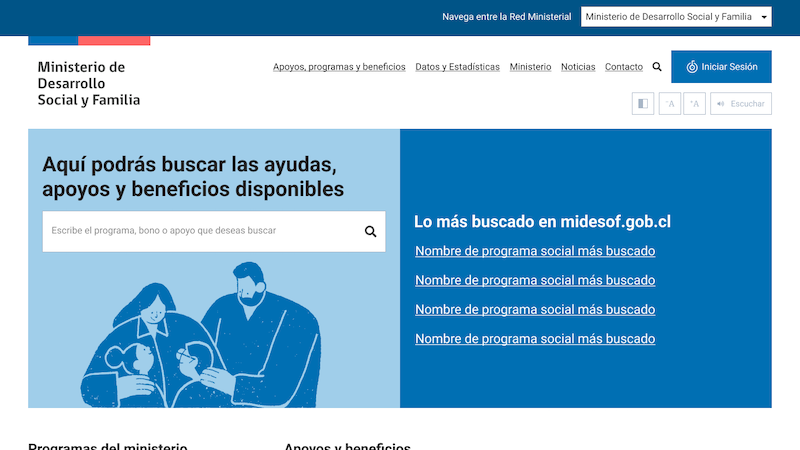
- This engagement laid the groundwork for the 2023 MIDESOF website redesign, where I returned to lead a more comprehensive transformation of the ministry's entire digital presence
Connection to Later Work
Four years after this project, I returned to the same ministry — now renamed Ministerio de Desarrollo Social y Familia (MIDESOF) — to lead a full-scale website redesign (2023). That engagement expanded the scope from a single benefits platform to the ministry's entire web presence, including the "Red MIDESOF" network of 100+ microsites. The life-event navigation model and citizen-first content strategy validated here informed the architectural decisions of the later project.