Links
-
Chrome's 2025 Web Platform Features: Customizable Components and Next-Gen Interactions
There are some features I'd like to try on this website, but I'll have to wait for browsers to catch up. If there's something that has evolved well over time, it's CSS.
-
On 10 Years of Writing a Blog Nobody Reads
Given that the majority will likely opt for AI-generated text, the ability to express ideas logically and clearly will hold a very different value ten years from now. The fact that only ten people read your blog a week doesn't really matter; the goal is something else.
"The introduction of GenAI has increased the surplus of written content to infinity, essentially. So from an economics standpoint, without any resource scarcity the value of written words has been reduced to zero. But is there still value in human produced writing? Subjectively, yes. Objectively? I'm not sure. I think there's a lot of personal value in writing though."
-
It's been a very hard year
I truly empathize with the pain conveyed in this article, and I understand why, at times, it is worth going against the grain. However, sadly, I do not believe the AI disruption will fade away like the Metaverse or the crypto hype did.
As with any industry facing such a radical disruption, front-end development will go through an initial phase of pain, insecurity, and hopelessness. But in the long run, I am certain that 'purely human-created' code will be reserved for a small niche of studios. They will be the exception—like the 'sushi master' with a months-long waiting list who only produces a few pieces a day. The value will lie in clients being able to say their site was built by an 'anti-AI' developer, one of the handful who still practices it as a trade rather than a nostalgic hobby.
For 99% of the market, the business will rely on a hybrid model combining human development with the supervision of AI agents, cutting the time for complex tasks down to hours or a couple of days. Betting against the market is a complex gamble, especially in software. Spare yourselves the suffering; you are not saving the world by refusing to let an agent build a navigation menu. That train left the station way back in 2022.
"Why am I writing this? All of the above has had a really negative effect on us this year. Landing projects for Set Studio has been extremely difficult, especially as we won't work on product marketing for AI stuff, from a moral standpoint, but the vast majority of enquiries have been for exactly that. Our reputation is everything, so being associated with that technology as it increasingly shows us what it really is, would be a terrible move for the long term. I wouldn't personally be able to sleep knowing I've contributed to all of that, too."
-
A good way to mess with bots
A creative approach to dealing with malicious bots that scrape for vulnerabilities like .env files and misconfigured instances.
"Now, the AI scrapers are actually not the worst of the bots. The real enemy, at least to me, are the bots that scrape with malicious intent. I get hundreds of thousands of requests for things like .env, .aws, and all the different .php paths that could potentially signal a misconfigured Wordpress instance. These people are the real baddies."
"Now, the AI scrapers are actually not the worst of the bots. The real enemy, at least to me, are the bots that scrape with malicious intent. I get hundreds of thousands of requests for things like .env, .aws, and all the different .php paths that could potentially signal a misconfigured Wordpress instance. These people are the real baddies."
-
Kagi Search Launches SlopStop to Combat AI-Generated Content
Kagi introduces a community-driven system to detect and downrank low-quality AI-generated content in search results.
"Kagi Search has launched SlopStop, a community-driven system to detect and downrank deceptive AI-generated content (called 'AI slop') in search results. Users can flag low-quality AI content across web pages, images, and videos, which Kagi will verify and use to downrank domains that primarily publish AI-generated material."
"Kagi Search has launched SlopStop, a community-driven system to detect and downrank deceptive AI-generated content (called 'AI slop') in search results. Users can flag low-quality AI content across web pages, images, and videos, which Kagi will verify and use to downrank domains that primarily publish AI-generated material."
-
LLMs are steroids for your Dunning-Kruger
Perhaps the best soft skill for dealing with a world where LLMs and Agents are trying to dominate our lives and work is the self-awareness of how much of what comes out of that black box is truth versus "hallucinations".
"After discussing an issue with an LLM I feel like I know something — a lot, perhaps — but more often than not this information is either slightly incorrect or completely wrong. And you know what? I can't help it. Even when I acknowledge this illusion, I can't help chasing the wonderful feeling of conviction these models give. It's great to feel like you know almost everything"
"After discussing an issue with an LLM I feel like I know something — a lot, perhaps — but more often than not this information is either slightly incorrect or completely wrong. And you know what? I can't help it. Even when I acknowledge this illusion, I can't help chasing the wonderful feeling of conviction these models give. It's great to feel like you know almost everything"
-
AI spending and the job market of 2025
In Chile, we have a game called 'musical chairs': everyone walks around a circle of chairs while the music plays. Each time the music stops, everyone must sit down, and whoever is left without a chair is eliminated. The game continues with fewer and fewer chairs each round. The race to dominate the future of AI increasingly looks like this game, where only one big company will emerge victorious.
"I maintain that companies have overspent on LLMs before establishing a sustainable financial model for these expenses. We've seen this act before. When companies are financially stressed, a relatively easy solution is to lay off workers and ask those who are not laid off to work harder and be thankful that they still have jobs. AI is just a convenient excuse for this cost-cutting."
"We're running out of simple ways to secure more funding, so cost-cutting will follow, Pratik Ratadiya, head of product at AI startup Narravance, wrote on X. "I maintain that companies have overspent on LLMs before establishing a sustainable financial model for these expenses. We've seen this act before. When companies are financially stressed, a relatively easy solution is to lay off workers and ask those who are not laid off to work harder and be thankful that they still have jobs. AI is just a convenient excuse for this cost-cutting.""
-
AI benchmarks are possibly just marketing
A study by the Oxford Internet Institute and other institutions reveals that most large language model (LLM) benchmarks lack rigorous scientific methods, with only 16% using sound measurement techniques. Many benchmarks claim to assess abstract concepts like reasoning or harmlessness without clear definitions or measurement criteria.
[GPT-5] sets a new state of the art across math (94.6 percent on AIME 2025 without tools), real-world coding (74.9 percent on SWE-bench Verified, 88 percent on Aider Polyglot), multimodal understanding (84.2 percent on MMMU), and health (46.2 percent on HealthBench Hard)—and those gains show up in everyday use, OpenAI said at the time. But, as noted in the OII study, 27 percent of the reviewed benchmarks rely on convenience sampling, meaning that the sample data is chosen for the sake of convenience rather than using methods like random sampling or stratified sampling.
"[GPT-5] sets a new state of the art across math (94.6 percent on AIME 2025 without tools), real-world coding (74.9 percent on SWE-bench Verified, 88 percent on Aider Polyglot), multimodal understanding (84.2 percent on MMMU), and health (46.2 percent on HealthBench Hard)—and those gains show up in everyday use, OpenAI said at the time. With GPT‑5 pro's extended reasoning, the model also sets a new SOTA on GPQA, scoring 88.4 percent without tools. But, as noted in the OII study, Measuring what Matters: Construct Validity in Large Language Model Benchmarks, 27 percent of the reviewed benchmarks rely on convenience sampling, meaning that the sample data is chosen for the sake of convenience rather than using methods like random sampling or stratified sampling."
-
Futurology AI 2027
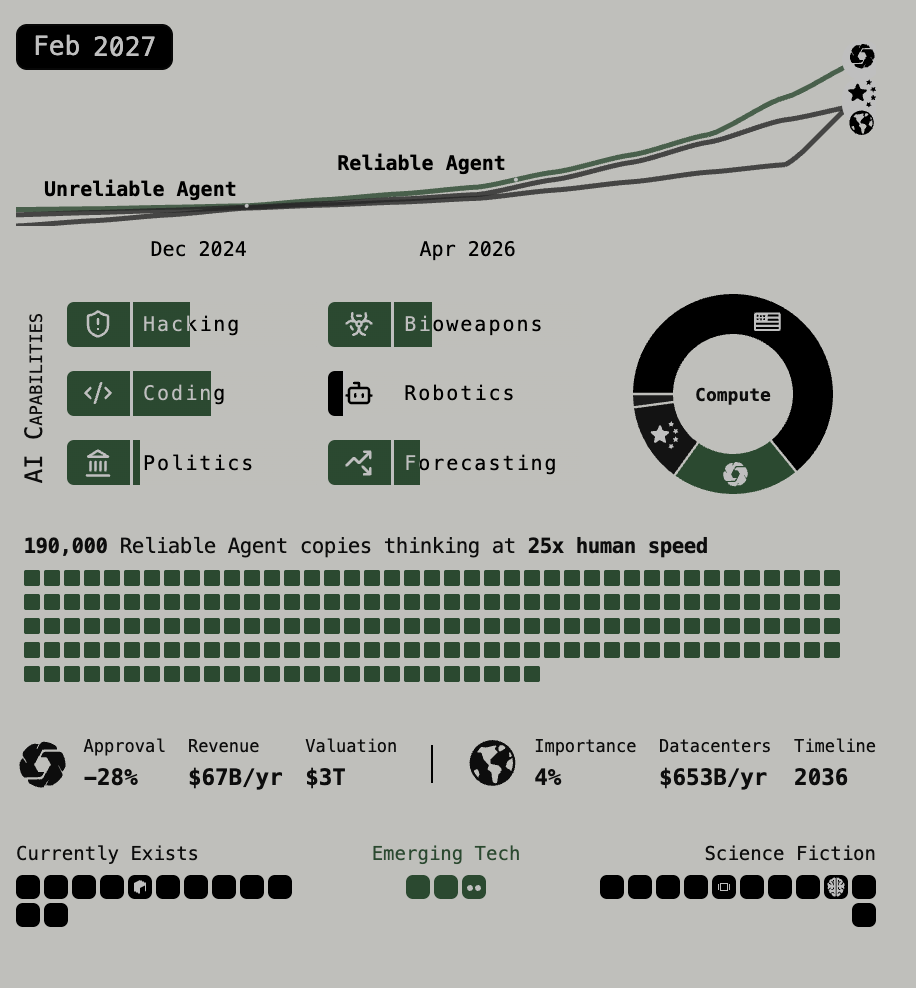
Predictions are the worst business to be in. Daniel Kokotajlo and Scott Alexander present a very detailed vision of what they think will happen with AI from now until the end of 2027.
Their bet is that the impact of LLMs and AI in general will be greater than the industrial revolution, with implications not only for the labor market but also for national security, geopolitics, and the economy.
If even just 30% of this turns out to be correct, the world that awaits us in a few years will be quite different.
I can't help but mention the excellent animation of how the changes evolve as the months pass on the original site.
"We predict that the impact of superhuman AI over the next decade will be enormous, exceeding that of the Industrial Revolution."
-
IndieWeb: A People-Focused Alternative to the Corporate Web
The IndieWeb has shifted my view of the future of personal websites. I’ve returned to blogging for the same reasons they champion: owning your domain, publishing on your own site, and maintaining editorial control.
"When you post something on the web, it should belong to you, not a corporation. By joining the IndieWeb, your content stays yours and in your control."